Roller Conveyor Shot Blasting Machine:
What We’ve Learned Building Them for 32 Years
[By Ding Renxiang, Chief Engineer & Technical Director]

I’ve spent over 30 years designing and refining shot blasting systems at ATHI. The projects that stick with me most are the ones that pushed our engineering limits — an automotive parts cleaning line for a factory in Greece, a railway-dedicated heavy-duty cleaning system for China’s rail industry, and a custom 5.2-meter-wide plate blasting machine for a shipyard in Dalian. Across 5,000+ clients across 70+ countries and counting and counting, each installation has taught us something new about what these machines need to do in the real world — and what corners you should never cut.
This guide is I’ve learned distilled into one place: how a roller conveyor shot blasting machine actually works, what the spec sheet numbers mean in practice, how the major components interact, and the mistakes I’ve seen buyers make that cost them time and money. Whether you’re specifying your first machine or replacing an aging line, I wrote this to help you make a better decision.
What This Machine Actually Does
A roller conveyor shot blasting machine is a pass-through cleaning system. Steel workpieces — plates, beams, profiles, welded assemblies — ride through the machine on motorized rollers. Inside the blast chamber, spinning blast wheels throw steel abrasive at high velocity against every exposed surface, stripping away rust, mill scale, welding slag, and old coatings.
The result is a uniformly cleaned surface graded Sa 2½ or Sa 3 per ISO 8501-1. That’s the surface quality that coating manufacturers specify for proper paint adhesion. Skip the blasting and you get coating failures — I’ve seen brand-new steel structures start peeling within months because someone tried to paint over mill scale.


How It Works, Step by Step
Let me walk you through what happens when a steel plate enters one of our Q69 machines:
The plate loads onto the infeed roller conveyor. All our rollers run on VFD (variable frequency drive) motors, so the operator — or the PLC — can dial the speed anywhere from 0.5 to 4.0 m/min. For heavily corroded plate, you slow down. For light mill scale, you speed up. On our newer machines, laser sensors automatically measure the workpiece dimensions as it enters, and the control system adjusts blast parameters without anyone touching a button.
The plate enters the blast chamber. This is a sealed box built from heavy plate steel, lined floor-to-ceiling with Mn13 high-manganese wear plates. Mn13 work-hardens under impact — the more it gets hit, the harder the surface becomes. That’s why we use it instead of mild steel liners that some budget manufacturers substitute.
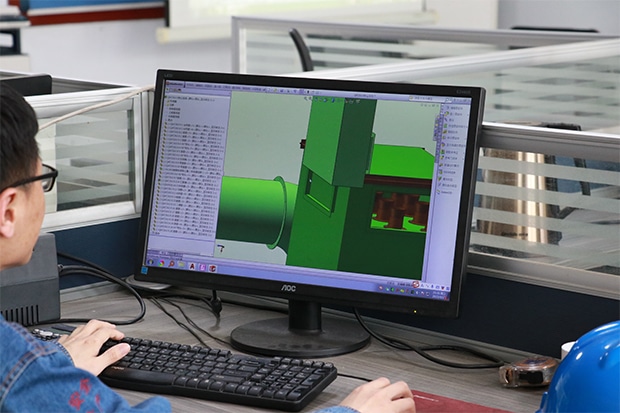
Inside the chamber, 4 to 12 blast wheels (depending on the model) are positioned in a 3D layout we simulate before manufacturing. Each wheel spins at high RPM, throwing steel shot or grit in a controlled fan pattern. The layout matters enormously — poor wheel positioning creates dead zones where rust survives. We’ve spent years refining our arrangements, and it’s one of the things our patents cover.
After blasting, the plate passes through a three-stage sweeping system: bi-directional screw conveyors collect loose abrasive, nylon roller brushes scrub the surface, and high-pressure air blowers blow off anything remaining. This sounds like a minor detail, but it’s actually critical. Residual steel shot trapped on a plate surface will create defects under the paint film. We’ve had customers switch to us from other brands specifically because their old machine’s sweeping system wasn’t thorough enough.
Meanwhile, the used abrasive falls to the chamber floor and enters the recovery loop: screw conveyors → bucket elevator → air-wash separator. The separator removes broken shot, rust particles, and dust, returning only good abrasive to the blast wheels. The dust goes to a pulse-jet bag filter or cartridge collector that brings airborne particulates below 15 mg/m³. Noise stays within 80–90 dB(A) with our sound-dampening panels and sealing curtains.
The cleaned plate exits on the outfeed rollers. Total time from entry to exit depends on plate length and speed — a 6-meter plate at 2 m/min takes about 3 minutes.
➤ Want to see this process running on a workpiece similar to yours? Send us a quick description and we’ll share the closest case video from our project library.
→ [email protected]
Q69 Shot Blasting Machine Series Specifications
Here are the standard configurations. I’m including these because spec sheets from some competitors leave out key details like dust collection airflow, which tells you a lot about environmental compliance.
|
Model |
Width mm |
Opening W×H |
Length mm |
Speed m/min |
Wheels unit×kg |
Dust Air m³/h |
Power kW |
|
Q6910 |
1,000 |
1000×260 |
1.2–12k |
0.5–4 |
4×250 |
12,000 |
78 |
|
Q6912 |
1,200 |
1200×600 |
1.2–12k |
0.5–4 |
4×250 |
17,560 |
78 |
|
Q6915 |
1,500 |
1500×700 |
1.2–6k |
0.5–4 |
4×250 |
19,000 |
114 |
|
Q6920 |
2,000 |
2000×800 |
1.2–12k |
0.5–4 |
6×250 |
19,550 |
157 |
|
Q6925 |
2,500 |
3000×900 |
3–12k |
0.5–4 |
6×250 |
27,758 |
160 |
|
Q6930 |
3,000 |
3000×1000 |
5–12k |
0.5–4 |
8×180 |
28,000 |
171 |
|
Q6940 |
4,000 |
4000×1000 |
6–18k |
0.5–4 |
8×360 |
38,000 |
294 |
Beyond 4 meters: These are standard models. We’ve delivered custom machines with effective widths of 6m for clients. If your plate is wider than the table above, that’s not a problem — it’s a conversation.
A common buyer mistake: choosing a model based only on plate width, without considering plate thickness and corrosion severity. A 3-meter plate with heavy rust may need more blast wheels (or slower conveyor speed) than the standard Q6930 configuration provides. Always discuss your actual material condition with the manufacturer.
Where These Machines Get Used
The short answer: anywhere steel gets fabricated at scale. Our Q69 machines are running in steel structure plants, shipyards, wind-tower factories, pressure-vessel shops, and steel service centers across 80+ countries. The longest-running installation I know of personally is a pretreatment line we built for a major Chinese steel-structure company — it’s been running continuously for over 5 years without a major overhaul.
Why We’re Different (Honestly)
I know every manufacturer says they’re the best. Here are three things about ATHI that are verifiable, not just marketing:
We wrote the standard. ATHI isn’t just a standards participant — we are the Secretariat of SAC/TC186/SC3, China’s national standards subcommittee for shot blasting equipment. That means every shot blasting standard in China is coordinated through our office in Qingdao. We’ve chaired 12 standards to date (11 industry + 1 national), including JB/T 14551-2025 and JB/T 14552-2025 for roller-type machines, and participated in 6 ISO international standards and 18 national standards. You can verify all of this on China’s national standards database (std.samr.gov.cn) or the SAC/TC186 committee records.
We hold 61 patents and IP assets. That includes 7 invention patents and 49 utility model patents covering roller conveyor shot blasting machines (patent for “Roller Conveyor Shot Blasting Machine”), wide-plate blasting machines (patent for “Wide-Width Steel Plate Shot Blasting and Cleaning Machine”), abrasive separators, elevator anti-drift mechanisms, pretreatment line preheating and drying systems, and paint-dry integrated systems, plus 5 software copyrights for our control systems. These aren’t shelf patents — they’re engineering solutions you can feel in the machine’s cleaning consistency, component lifespan, and energy efficiency.
We say no when the spec doesn’t fit. If a customer’s workpiece would be better served by a hanger-type or tunnel-type machine, we tell them. Selling someone the wrong machine type costs both sides — we’d rather lose a sale than build a reputation problem.

Questions We Get Asked Most
How long does it take to deliver?
55–70 working days from order confirmation for standard models. Installation and commissioning run 30–45 working days. We support overseas installation with 3D simulation packages and remote video guidance — our Indonesian customer installed their Q6918 entirely on their own using this method.
What’s the warranty?
12 months, covering all manufacturing defects. We include a recommended spare-parts package, remote diagnostics, and operator training. Extended service agreements are available.
Can I visit your factory?
Absolutely. We’re in the West Coast New Area of Qingdao, about 45 minutes from Qingdao Jiaodong International Airport. We welcome factory visits and can usually arrange a running-machine demonstration.
How does the Q69 compare to competitors’ machines?
We’re not going to trash-talk other manufacturers. What I will say is: ask any supplier whether they authored or merely follow the industry standard, whether their blast-wheel layout is simulated or assumed, and whether they can show you dust-emission test reports from an independent lab. The answers will tell you a lot.
➤ Tell us what you’re blasting. We’ll reply within 24 hours with a technical recommendation, not a sales pitch.
→ [email protected] →WhatsApp: +86 15712771009