We’ve Cleaning Steel Plates Over 5 Meters Wide. Here’s What It Takes.
[By Grace, Mechanical Design Lead | ATHI 12 years specializing in plate-processing lines]
Plates Are Not the Same as Profiles
Early in my career, I assumed a shot blasting machine was a shot blasting machine — if it could clean an H-beam, it could clean a plate. That’s wrong, and the mistakes are expensive.
Steel plates present three challenges that profiles don’t: they’re wide (often 2–5+ meters), they’re thin relative to their surface area (so they vibrate under blast impact), and they’re processed in high volumes (hundreds of square meters per shift). A steel plate shot blasting machine needs to be specified differently from a general-purpose roller conveyor machine.
The Spec Decisions That Actually Matter
Effective width — and the margin you need
Your machine’s effective cleaning width needs to exceed your widest plate by at least 100–200 mm on each side. That margin accounts for plate wander on the rollers. Our standard Q69 roller conveyor shot blasting machine range tops out at 4,000 mm effective width (the Q6940), but we’ve built custom machines up to 5,200 mm for a shipyard in northern China. Going beyond 4 meters means a custom-engineered chamber and roller bed — it adds to the project timeline, but we’ve done it enough times that the process is mature.
Blast wheel layout for flat surfaces
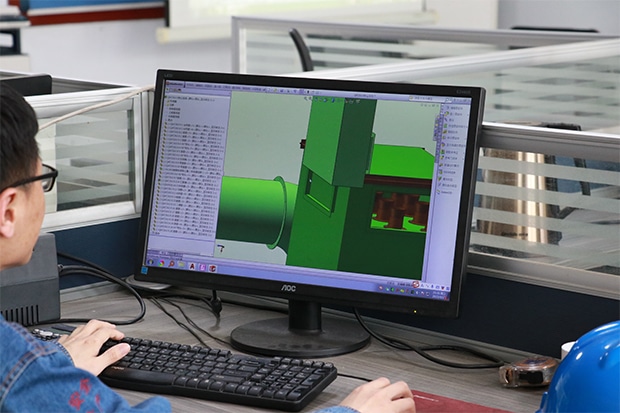
Plates need a different wheel arrangement than beams. For flat work, we use a higher proportion of top-firing wheels angled to overlap their throw patterns, ensuring no streaking. If you’ve ever seen a blasted plate with faint parallel lines of remaining scale, that’s usually a wheel layout problem. Our 3D simulation catches this before the machine is built.
Roller spacing and vibration control
Thin plates (under 12 mm) bounce and vibrate under blast impact. We space rollers more closely in the blast zone for thin plate work and use damped bearing mounts. Some competitors use the same roller pitch regardless of plate thickness — ask about this if you’re processing thin material.
The sweeping system nobody talks about
I spend more time discussing sweeping systems with customers than any other component. Residual abrasive on a plate surface is invisible to the naked eye but creates bumps under the paint film. Our triple-action system (screw + brush + air) is significantly more thorough than a single blower, which is what many budget machines offer.
➤ Processing plates wider than 2.5m? Let’s discuss your specific dimensions. → [email protected]


Integrating Into a Complete Pretreatment Line
A standalone steel plate shot blasting machine solves the cleaning problem, but the real efficiency gain comes from connecting it to a complete pretreatment line: blasting → preheating → spray painting → drying. Our QXY series shot blasting machine does exactly this. The plate never leaves the roller conveyor between processes, which eliminates manual handling, prevents flash rust, and synchronizes the entire production takt.
Lead time for a complete line is typically 70–90 working days, depending on the painting and drying specifications.
➤ Want a turnkey line proposal? Send us plate dimensions + daily capacity target + available floor space. We’ll respond with a 3D layout and budget within 48 hours. → [email protected]